Showing posts with label project 365. Show all posts

Friday, February 26, 2016

Project 365: Movies 288 - 294

288 / 365: Suffragette (2015)
© Focus Features

I don't know how many of you were a mess of tears when you saw this film's trailer in the theater, featuring a cover of Fleetwood Mac's "Landslide," sung by Robyn Sherwell, but it was enough to make me think that this could easily be the best film of the entire year. That's how effective the trailer was. Sadly, the film didn't quite live up to the promise of it's advertisements, though admittedly, the snapshot provided in the 2+ minute preview is, in fact, as perfectly succinct—and almost more emotional—version of the actual film.

In early 20th-century Britain, Maud Watts (Carey Mulligan) has been working as a laundress since she was seven years old. Now a wife and mother, the mild-mannered Maud befriends fellow laundry-worker, outspoken Violet Miller (Anne-Marie Duff), who encourages her to join the underground suffragette movement in an attempt to fight for their rights as women—and mothers. Inspired by the infamous Emmeline Pankhurst (Meryl Streep), a political activist and leader of the suffragette movement in London, Maud begins to find her voice as she engages in peaceful—and not so peaceful—protests in the face of police aggression and injustice. Risking their jobs, families, and lives, Maud and her compatriots fight selflessly to change the course of history.

The first thing that I noticed was that the film was structurally confounding, and the arc of the storytelling was limited by how the scenes were organized. Sequences, moments, dialogue, whatever it may be, anything of emotional depth or inspirational gravitas never seemed to hit at the right time. There was a lot of build-up to Streep's Pankhurst, who acts more as an inspirational figure than an active participant in the on-the-ground cause. Yet her reveal comes mid-way through the film, which means that it's bookended by a flurry of activity that deflates the entire sequence's importance. Had she appeared at the start, or maybe the end, the build up would have been justified and added just the right touch to aide Maud in her journey.

Otherwise, the significance of the story isn't lost on us, and Mulligan is a spectacular leading lady. I consider her a premiere talent, and I'm never without positive things to say about any one of her roles. The same is true for her performance as Maud Watts. She goes through a tremendous transformation during the course of this story, and it never feels forced, like its only for a desperate emotion-grab. Her tears and fire and anger are palpable, particularly in her scenes with her young son. It was impossible not to feel a drive right alongside her. The difficulty is trying to translate that same personal journey into such a massive political movement, one that—when we're taken away from Maud's story—feels more like a history lecture, and a dragging one, at that. But just watching the scene when Maud comes face-to-face with the Police Inspector, played by Brendan Gleeson, is worth the price of admission.

Rating: ★★★ / 5 stars
Watched: Theater
Seen Before: No

289 / 365: Anomalisa (2015)
© Paramount Pictures

Just look at this image of the shooting process, an exhausting construction of movements and shifts that would be enough for even the most patient filmmakers to lose their minds. Part of watching any Charlie Kaufman film is noticing the minute details that he incorporates, and oftentimes, figuring out how the hell he did it, and Anomalisa is no different. The script has a mighty message, one that changes its tune mid-way through, but that challenges the viewer to accept that life just might be as meaningless, or as meaningful, as we make it. Oh, and it also features the most realistic sex scene I've ever seen—between two puppets.

While on a one-day business trip to hold a seminar in customer service, author Michael Stone (David Thewlis), moves about his routine with disinterest, interacting blandly with those he must, but never attempting to make a connection with anyone. The purpose of his life appears to have diminished, even as it relates to his own wife and child—that is until he hears the voice, and sees the face, of a stranger named Lisa (Jennifer Jason Leigh), who is staying at his hotel. From his perspective, she just might be the most special person in the entire world, and quite possibly the cure for his apathetic, mundane existence.

Thematically is where I begin to have issues with the otherwise flawless execution of the puppetry/stop motion. The entire concept of the film's first half hinges on the idea that life is a monotony of continuous sameness. That as you get older, it becomes obvious that people are just inherently the same, with the same selfish, boring desires. But the first half is hopeful, because, as Michael discovers, sometimes, there will come into your life a person that stands out from the rest, and shows you just how brilliantly unique and special life can be. A powerful, life-altering discovery that Kaufman handles with absolute brilliance. Lisa is so relatable, and she makes Michael relatable, and the way their relationship comes about is easily the most touching aspect of the film.

But then the shift. The very Kaufman-esque one that I should have known was coming, because things were just going too damn well for these characters. I don't want to spoil the last part of the film, but it's a huge factor in my not loving it more. When Michael experiences a very obvious shift in his perspective about Lisa, about his life... there is no more dismal reveal than this. What a damn disappointment. The transition that Michael is making to truly accepting that life can be a joy is cut down at the knees, and us optimists are left with our mouths hanging out, with pessimists left nodding their heads. Your enjoyment of this film really will hinge on if you're a "glass half empty" or "glass half full" kinda person.

Rating: ★★★½ / 5 stars
Watched: Theater
Seen Before: No

290 / 365: The Hateful Eight (2015)
© Warner Brothers

Many mixed emotions here. What I love about Quentin Tarantino is ability to write an irreverent script and incorporate bloody gore in a way that doesn't make my stomach turn. Tarantino was never about that, even when the violence was brutal and disturbing (Django Unchained and that dog scene comes to mind). In The Hateful Eight, moments of absolute bloody decimation were broken up only by shots of sprawling landscapes and fur trappings used for impeccable interior design—oh, and some pretty fantastic acting. But for the first time since the gimp scene in Pulp Fiction, I found myself unsettled more than I was entertained.

Navigating the vast wilderness and sensing an impending storm, bounty hunter John Ruth (Kirk Douglas) comes along another bounty man, Major Marquis Warren (Samuel L. Jackson), in need of transport. With the Major's bounty dead, Ruth agrees to bring him along with him to the nearby town of Red Rock, so long as the man keeps his distance from his live fugitive captive, Daisy Domergue (Jennifer Jason Leigh)—the most wanted member of the Domergue gang, and he's taking her to Red Rock to hang. The two men then encounter Red Rock's new sheriff, Chris Mannix (Walton Goggins), stranded on the road, so with the blizzard ranging to the point of white out, Ruth has the group seek refuge at an establishment he's frequented often, Minnie's Haberdashery.

But when they arrive, they meet many new, unfamiliar faces—and no Minnie. Bob (Demián Bichir) is overseeing the place while Minnie is away, and a few guests have already settled in: cowboy Joe Gage (Michael Madsen), Red Rock's hangman Oswaldo Mobray (Tim Roth), and an old Southern general, Sandford Smithers (Bruce Dern). Fearing the loss of his bounty, Ruth establishes rules among the tense, untrusting group, and it isn't long before the eight travelers are trapped inside this cabin, with nothing to do but turn against each other. That is, unless the bounty hunters can uncover the truth behind who these men are, and what they want.

While most audiences are applauding Ennio Morricone's score and the lengthy vista shots of the 70mm edition (for good reason), I was—and still am—most taken with Yohei Taneda's production design. It was distracting in its beauty and detail, and the pacing of the story was comparable to watching a perfectly executed play, with a set to match. The perpetual movement through the cabin's distinct sections, the props littering the walls, shelves, arm chairs, and tables, rich with texture. How each piece catches your eye—as a distraction—but eventually comes into play later in the film with significant purpose. I was taken by it immediately, and it remains my favorite thing about the film. The script is a close second. Witty and disgusting, Tarantino does what he does best. The only difference here is that I didn't quite enjoy watching what I was hearing.

No one knows how to genre-twist like Tarantino. As likely the biggest cinephile making movies today, his attention in recent years has veered from dark noirish crime, to warped historical period myths, steeped in delightful untruths. Where Inglorious Basterds and Django managed to align the audience with whomever you perceived as the "good guys," there isn't a good guy to be found this time around. That's really what makes it so boldly brutal. Kirk Douglas' John Ruth may be as close as we'll get to a hero, but even he can't stand up against the treachery for long. Sam Jackson delivers some incredible monologues here, though he never shakes his common Tarantino persona. But he certainly does the most sleuthing, and that, in the end, is what this film is all about. Like a demented Agatha Christie/Murder on the Orient Express 'whodunit', Tarantino weaves together humor and outrageous violence that, at times, is a tough pill to swallow.

Jennifer Jason Leigh deserves a call out at this point, because she gives, hands down, the most carelessly wild performance of the year. Her character is downright appalling, crude and broken, with an appalling sense of humor. And Leigh f*ckin' delivers. Now, having said that, I'm still cringing at the beatings she takes at the hands of her captors, and there is a disconnect between the tone of the film and the story we're watching play out. The physical action we're seeing just doesn't match the comedic air of the editing and dialogue, and I'm left wondering why I'm not enjoying this whole experience more. For Tarantino's eighth feature film, I can't think of a story more appropriate, but despite the brilliant pieces that are impossible to overlook, The Hateful Eight doesn't quite come achieve the heights of is more recent masterpieces.

Rating: ★★★★ / 5 stars
Watched: Theater
Seen Before: No

291 / 365: Scrooge (1970)
© National General Pictures

There must be something about Charles Dickens' A Christmas Carol that just begs to be re-written as a musical. All of the best versions are, be it on stage or screen, and this one was introduced to me by my boyfriend and his family, who grew up on it—kind of like how I grew up on my #293 movie below. This is a simple, and incredibly magical story, and not a single beat is missed as Albert Finney takes on the role of Ebenezer Scrooge, an bitter old man with no patience for Christmas spirit... that is, until three of them—the Ghosts of Christmas Past, Present, and Future—come to visit him on the night of Christmas Eve...

Albert Finney does Scrooge justice, though he edges on silly at times. A result of his wearing old age makeup and trying to act old, very likely, but it isn't a distraction. He does have the kick in his step that grows happier and happier throughout the film, and he plays it joyously. The ghosts are typical of this story, but conceived well. And no other take on this movie can claim Obi Wan Kenobi as their Jacob Marley.

The connection to all things Christmas is so dependent on your experience as a child. If you grew up singing hymns, those will always hold a nostalgic, special place in your heart, even if in your adult life, you aren't religious. When you were young, if you opened presents Christmas morning rather than Christmas Eve, that desire continues to build out into your traditions with your children. I feel the exact same way about Christmas movies, particularly adaptations of this all-too-familiar tale. This was my very first time watching this, and it was wonderful. A top-notch re-telling that incorporated songs (my favorite element; seriously, this plot is so "singable"), which brings it as near to my all-time favorite Christmas movie as one could hope to get.

But no matter how hard it may try, or how much it might deserve it, it simply can't hold a candle to what I loved as a kid. My boyfriend swears by this version, but that's his childhood talking, just like mine.

Rating: ★★★½ / 5 stars
Watched: Blu Ray
Seen Before: No

292 / 365: It's a Wonderful Life (1946)
© RKO Radio Pictures

[I watched this movie as part of my Project 365 (it was Christmas, how could I not??), but will review it in full when it comes up at #20 on the AFI Top 100]

293 / 365: The Muppet Christmas Carol (1992)
© Buena Vista Pictures

Residing in a permanent position as my #1 Christmas movie of all time, and the first Muppet film not to headed by Jim Henson himself. But the homage to his legacy and his characters has never been stronger than in this feature film, where all of his very best creations get to join in on the fun and the irreverent joy. The timeless story of the miserable miser, determined to stomp on the happiness of Christmas, who comes face to face with his Past, Present, and dismal potential Future, thanks to three very different ghosts.

Michael Caine is the best Ebenezer Scrooge that has ever been. Maybe I'm biased... Nope. I'm not. He's the best. He plays this role, a complicated and very easy-to-over-act miser, as if it were Shakespeare. Oh, and did I mention he did it alongside the Muppets? Not for one single second on screen does Caine play down the part because of his co-stars, or give away that this just might be a version for children. He is truly one of the greats, and this is evidence of his true talent and professionalism. Nothing he does is played for a laugh, even though he's funny on many occasions. I'm still in awe of his performance, because he could have phoned it in, but he didn't. And more than that, he adds a seriousness to the story—and legitimizes the Muppets themselves—as true characters of fiction.

The best Muppet movies are the ones where the Muppets themselves have a place to "fit." Adapting classic stories where each familiar face can slip seamlessly into the character—a name tweak here, a tongue-in-cheek play on words there—and A Christmas Carol has a place for everyone. And I mean everyone (the red-headed step-child of the Muppets, Bean Bunny, whom I adore, even finds his purpose in this story). Kermit as Bob Cratchet is perfection, and Fozzi as Fuzziwig Fozziwig? Pure genius. Is there any story more ideal for a Muppet takeover than this one? I think not.

Lastly, the songs. From "One More Sleep 'Till Christmas" to "Bless Us All" to, of course, the finale "Thankful Heart," there is a beautiful, emotional track to represent each significant beat. And this Muppet version is unique in that is includes a Narrator, and a 4th wall breaking interaction with the viewer. Gonzo and Rizzo the Rat lighten the heavy nature of the story and bring light to the film, and it offers a consistency that you don't know you've missed until it's gone. A film from my childhood that will become required viewing for my future children, and one that continues to be staple during our holiday celebrations.

Rating: ★★★★½ / 5 stars
Watched: Blu Ray
Seen Before: Yes

294 / 365: The World's End (2013)
© Universal Pictures

It's been 20 years since Gary King (Simon Pegg) and his school mates attempted to tackle—and fail to complete—the country's most epic pub crawl in their hometown. Now, at 40 years old, a now embarrassingly immature and selfish Gary views this moment of his youth the pinnacle of his existence, and it's about time he finish what he started, with those who walked alongside him. When he eventually convinces his old friends—all of whom have grown up and moved on—to join him on this school boy dream, even though he is completely blind to the very real fact that every single one of them hates him, and maybe always did. As old wounds and memories open up, ignored completely by Gary, they soon discover that something just isn't right with the people in their old stomping ground... and it may take more than iron livers to get them through 12 pints in 12 pubs and make it to their final stop, The World's End.

Pegg plays Gary as so despicable, there is no amount of pity in the world that could make up for it. They don't even really try very hard to make you feel bad for him. Sure, you get hints about how the guy has never grown up, how stuck in the past he is, how completely delusional he is... but you don't care. He's just too mean and too unlikable. The saving grace of the movie is that everyone else thinks so, too. This is Nick Frost's best "Pegg sidekick" character since Shaun of the Dead, and it stands out because, this time, he couldn't want to be around Pegg less.

Edgar Wright's editing style—the sweeping transitions and comedic slam cuts—is what reminds us we're watching a comedy. The plot itself begins to fall apart not long after it starts, because, like ticking boxes off a list, there's only so many places it can go. The revelation about the supernatural element here is hilarious, and the action is great during the bathroom scene when everything goes to hell. But from there, it devolves into a rocky, endless stream of 'the same.' The final climactic sequence is so over the top, it isn't even interesting anymore by the time we get there, and we're still having to endure Gary in all his self-obsession. Glad I saw this at least once, but now I don't have to watch it again.

Rating: ★★½ / 5 stars
Watched: Blu Ray
Seen Before: No

Tuesday, February 23, 2016

Project 365: Movies 280 - 287

280 / 365: Black Mass (2015)
© Warner Bros.

Johnny Depp takes on one of his more human roles in recent years, even though that role is a murderous mobster. Earning himself another Academy Award nomination (and another that he won't win), Black Mass is the under-appreciated crime thriller of 2015.

John Connolly (Joel Edgerton), is a born-and-bred South Boston native, now an agent in the FBI's Boston office. Desperate to make good and rise in the ranks of the Bureau, he tells his superiors that he has intelligence on prominent Irish Mob leader, James "Whitey" Bulger (Depp), who just so happens to be Connolly's childhood friend. While Whitey has visions to take down the Italian Mob that's infiltrating his territory, Connolly turns his—and the Bureau's—attention to the Italians, making a deadly deal with Whitey to inform on the business, giving the mobster veiled immunity to continue murdering, drug dealing, and racketeering. As Connolly gets in over his head, compromising his life and position in the process, Whitey begins a cat-and-mouse game with the FBI that eventually lands him on the Ten Most Wanted List.

I was most surprised by how unexpectedly funny and irreverent this story is, delivering a slew of captivating characters with plenty of depth. Now, it's not The Departed, but it sure tries to be. Connolly morphs into the strongest character of the bunch, because he's the one that you watch go through a total transformation. It's slow, and at first, understandable, the two-faced behavior as he's trying to get the intel that he needs. Edgerton is an unbelievable talent. Depp's performance is not subtle, but Edgerton's creeps up on you, revealing his as an equally dangerous player in this charade. And as ferocious and biting as Depp plays Bulger, he's still the most "normal" on screen character that Depp's played in a decade.

This is an exciting and interesting biographical crime film, one that takes a few liberties, but still manages to tell a hypnotic story with A+ talent.

Rating: ★★★★ / 5 stars
Watched: Theater
Seen Before: No

281 / 365: The Bridge on the River Kwai (1957)
© Columbia Pictures

This movie was the #36 film on my AFI Top 100 countdown challenge. Read my full review here.

Rating: ★★★½ / 5 stars
Watched: DVD
Seen Before: Yes

282 / 365: Cinderella (2015)
© Walt Disney Pictures

This new live action reboot trend is one that could be construed as nothing other than a blatant Disney cash grab. The notion that any of these classic tales need to be revisited suggests something about the original not being enough, even in dire need of a gloss and a spit-shine, and we should all be a bit irked by that notion. What's better than the animated Sleeping Beauty? Or The Jungle Book? Don't mess with perfection, people.

Thaaaaat being said, I'm unabashedly a sucker for pretty things. And quality execution in a movie like this depends on the ingredients, and for this live action Cinderella, the ingredients came together into an unexpectedly impressive brew. No need to recount the plot here. Nothing has changed, it is quite literally exactly the same, all the way down to pudgy mouse Gus-Gus. But the standouts lie in two places: Lily James as Cinderella, and the incomparable Cate Blanchett as her evil Stepmother. Blanchett's introduction is complete with her fluff cat bouncing out of their coach on a leash, for god's sake! A far more interesting performance than her turn as the titular Carol this year, which I'm sure will incite hisses from most people.

But it was. It was playful and fierce and it never feigned importance. The film is like that too. While it suffers the same fate as many fairy tale adaptations in that it's thematically hollow—and Disney can't help itself but cast Helena Bonham Carter as blithering twits (Helena... you're better than that)—Lily James is a commanding star. I can't remember the last time I saw a face so fresh and so bright, and she carries herself with a grace that is reminiscent of the most classic cinematic princesses. Oh, and need I even mention her ball gown? A delightful version of this famous story, one that I hope hints at the quality and care of the upcoming live-action reboots.

Rating: ★★★ / 5 stars
Watched: Blu Ray
Seen Before: No

283 / 365: Spotlight (2015)
© Open Road Films

With the true crime fever that's hitting the entertainment-scape (thanks to podcast Serial and everyone's recent obsession, Making a Murderer), it should surprise no one that Spotlight had the all the ingredients of an audience pleaser. Consolidating an overwhelming amount of information related to the true sexual abuse scandal of the Boston Catholic archdiocese and the investigation surrounding it, the film manages to succinctly inform us about a series of events that had more than a few moving parts. An impressive task, to say the least.

The year is 2001 when a new managing editor, Marty Baron (Liev Schreiber), is hired to oversee business at the offices of the Boston Globe newspaper. Neither a Catholic or a Boston native, Baron proactively tasks editor Walter "Robby" Robinson (Michael Keaton) and his three reporters—Mike Rezendes (Mark Ruffalo), Matt Carroll (Brian d'Arcy James), and Sacha Pfieffer (Rachel McAdams)—with investigating the fervent accusations of misconduct and sexual assault of children among clergy members of the Boston archdiocese. The journalist team, known as "Spotlight," works in secret to aggressively investigate each story, sometimes taking years to compile. When Robinson and the team, all reformed Catholics to one degree or another, stumble across evidence of a massive cover-up, they fight against the full strength of the Catholic church, and a community willing to turn a blind eye in order to keep their faith alive.

Aside from loving this movie and everything it stood for, some problems stand out. There were a handful of leads, moments that piqued my interest and kept me glued to me chair, that were then dropped, never to come back into play again in this whirlwind investigation. I'm thinking specifically about a scene in which Sacha goes knocking on doors and comes across a man who... well, let's just say that he says some very interesting things. Things that made even Sacha scramble in disbelief. The conversation ends and she's resolute with Robby that no matter what, she's going to follow-up on this lead. But she doesn't. One of the most interesting revelations in the film, the one I couldn't stop thinking about, was dropped like a bad habit (pun intended).

The lack of resolution, in fact, distracted me from the development of the rest of the story. While it may not have been the most important detail of Spotlight's story, it was one of the only pieces that provided any psychological or emotional explanation for what was really going on. I'm still sad we didn't get more of it, and the inclusion of this scene without any revisiting of it is a major oversight on the part of director Tom McCarthy and writer Josh Singer. It may seem small, but every person I mentioned it to since seeing this movie responded with "Oh yeah... what the hell happened there?" I can't be the only one that thought that should have been incorporated differently into the film.

The performances are spectacular, though no one really stole the show. McAdams is nominated for a Best Supporting Actress Oscar, but it's hardly her best role. The truth is that the entire film is impressive, thereby, everyone in it stands out. Thematically, it's likely the most mature film of the year, taking cinematic plays directly out of All the President's Men, and even seeing it through to the end of the investigation where we feel the full catharsis of the truth being revealed. The poetry of the written word, the power of print and newspaper journalism isn't lost on a single viewer. The days in which a team could, almost unregulated, go in search of answers to society's most impossible questions... Those days really might be gone, and that's why Spotlight feels so special, and so precious.

Rating: ★★★★ / 5 stars
Watched: Theater
Seen Before: No

© 20th Century Fox

[I watched this movie as part of my Project 365, but will review it in full when it comes up at #13 on the AFI Top 100]

© 20th Century Fox

Without question, the greatest Star Wars film in the franchise. It isn't because the script is better (it is) or because the acting is better (it really is). It's because The Empire Strikes Back is the first (and maybe even only) film in the series that knows exactly, at every beat, what kind of movie it is. It takes the right things seriously and doesn't get caught up in the little things, diving immediately into an action-packed story and wasting no time revisiting the past. With the controlling reigns taken away from over-zealous creator George Lucas, director Irvin Kershner and writer Lawrence Kasdan create one of cinema's greatest sequels—a balanced, emotional, and triumphant space odyssey.

The Death Star has been destroyed, and the Rebel base has been relocated to the ice planet, Hoth. Han Solo (Harrison Ford) has joined the Rebellion as a commanding officer, with Princess Leia (Carrie Fisher) and Luke Skywalker (Mark Hamill) driving the fight against the Empire right alongside him. When the Empire forces discover the base and take over the planet, Han and Leia, along with trusty companions Chewbacca and C-3PO, escape across the galaxy to get intelligence and test alliances—or rather, discover new enemies. Luke, unable to ignore his destiny to become a Jedi warrior, travels with R2-D2 to the swamp planet of Dagobah to train under Jedi master, Yoda (Frank Oz), with the hope of one day coming face-to-face with the villainous Darth Vader (James Earl Jones), and avenge the death of Obi-Wan Kenobi (Alec Guinness). Little does he know that it's Vader who will stop at nothing to find him.

Action sequences are spaced evenly throughout the film, and delicate care is taken with the dialogue and character development to tell a significantly more mature and human story than anything else to come out of the Star Wars universe. Betrayals are piercing and personal, and motivations are explored for each of our primary heroes. The surface-level, reactionary plot points are left to the original film; in Empire, the interplay between characters—be it romantic, sinister, vengeful, or hopeful—is complicated, layered, and bone-deep. Everyone feels so much more strongly this time around, and Kasdan makes sure that each actor has their apex. Lando's betrayel of Han in Cloud City remains my favorite scene of the series, because it's gut-wrenching and, due to Ford and Fisher's rock-solid chemistry, tragically romantic.

The older I get, the more nuance I see in this movie. The costume design is simplified (and more functional), the makeup is softer, and the galactic sets are epically scaled to be all-encompassing on the screen. The special effects stand the test of time, mainly because Lucas and the ILM team took advantage of puppetry whenever they could. The miniatures never feel that way—we're always treated to enormous pay-off with minimal distractions to tear us away from the story. The construction of the film is patient, less bombastic than its predecessor (and successor), which may be why it speaks to the cinema-phile rather than the sci-fi geek in me. While the newest revival by J.J. Abrams took similar care in its story-telling, nothing can compete with Empire, and I don't know that any Star Wars film ever will.

Rating: ★★★★½ / 5 stars
Watched: VUDU
Seen Before: Yes

© 20th Century Fox

When I was a child, there was no more incredibly awesome movie than Return of the Jedi (except maybe Grease 2). The colors, the variety of characters and puppets, the costumes, the EWOKS... what more could an 8-year-old want? This time around, director Richard Marquand takes the helm and delivers a far more flashy feature in this third (final of the original trilogy) venture into the Star Wars universe, and it's taken many years to recognize the faults in this otherwise nonstop action adventure. Taking a step away from the maturity of Empire Strikes Back and veering head-first into the realm of Jim Henson-esque storytelling, Jedi cranks the hijinks up to eleven and shoehorns the playful into the action at every turn. An approach that, while still enjoyable to this day, is better served to a young audience than its adult fans.

Not long after the events of Empire, the Empire has begun construction in secret of a new Death Star, and the Emperor has enlisted Darth Vader (James Earl Jones) as the commander of the project. With Luke Skywalker (Mark Hamill) in hiding and Han Solo (Harrison Ford) imprisoned for his gambling debts by Jabba the Hutt, Darth Vader is confident that they'll once again regain power over the galaxy. But when Princess Leia (Carrie Fisher), Chewbacca, R2-D2, and C-3PO fail to rescue Han from his carbonite prison and are captured themselves, Skywalker, now swathed in black with his Jedi skills refined, returns to his home planet of Tatooine to rescue them all. Tasked with a new mission to destroy the Death Star before it becomes fully functional, the group travels to the forest moon of Endor and, with the help of the native Ewoks, attempt to take down the Empire's last chance to rule the galaxy. Luke, however, cannot shake his selfish need to confront Darth Vader one last time, even if that means facing pressure to join the Dark Side of the Force.

The slapstick, cutesy comedy that permeates the action, particularly during the final climactic sequences on Endor and the rib-jabbing moments during the long opening scene on Tatooine are a major distraction from the otherwise brilliant conclusion to the trilogy. What made me love it as a kid made me deride it (a bit) as an adult. It doesn't change that the story itself is remarkably well constructed, tying up plenty of loose ends and keeping the momentum of the previous films moving right until the very end. But it does make me take it all a little less seriously. You don't notice it more than when you watch the two films back to back, and that's an unfortunate truth about the series. Consistency of character and theme get lost in the lack of consistency of tone.

With that said, it still manages to generate the same triumphant energy as the first film, especially at the end—and the weight of all that these characters have endured give it that much more significance. The joyous nature of the closing images left me completely satisfied—it's no wonder that it took Lucas another 30 years to tackle the next chapters... there really wasn't a need.

Rating: ★★★½ / 5 stars
Watched: VUDU
Seen Before: Yes

© Walt Disney Pictures

New movie release, reviewed previously on Through the Reels. Read the full review here.

Rating: ★★★★½ / 5 stars
Watched: Theater
Seen Before: No

Tuesday, February 9, 2016

Project 365: Movies 273 - 279

273 / 365: Brooklyn (2015)
© Fox Searchlight Pictures

This past year wasn't known for it's easy-breezy cinema. Most were wrought with violence, or injustice, or emotional turmoil, so to be met with a film this light and refreshing is almost unheard of this time of year. For that film to receive the awards recognition that it has goes to show how audiences were in need of more movies that have no more to say than "love will prevail." There are obvious elements of classic Hollywood cinema in Brooklyn, from the story itself to the romance to the exquisite costume and set design, proof that a happy ending doesn't have to feel trite or cliche, but can be absolutely necessary and welcome.

Young Eilis Lacey (Saoirse Ronan) finds a lack of opportunities in her small, cloistered Irish hamlet in the 1950's, and with the help of a family friend and Priest, makes the nerve-wracking and unfamiliar voyage across the Atlantic to Brooklyn, New York. Leaving behind her hopeful mother and older sister, Eilis is put up in a female boarding house for like-minded Irish transplants, and she soon realizes that her meek, quiet, and nervous nature may not get her too far in the fast-paced city. With a new job at an upscale department store, coming face to face with glamorous and confident women doesn't do anything to settle her nerves.

Wracked with homesickness and without any close friends, she's unexpectedly wooed by a sweet and playful Italian boy named Tony (Emory Cohen). As a whirlwind romance quickly transforms her life and outlook on her new home, she must put her new-found happiness on hold when tragedy calls her back to Ireland. With the call of two homes weighing heavily on her mind, Eilis must choose between the prospect of greater opportunities from her past... and the anticipation of a blissful future.

The film is refreshing in its lack of stakes. How personal it was counteracts our desire to see our protagonist encounter insurmountable trials left and right. She felt like an honest, real person, experiencing a new life—first crippled by homesickness, probably one of the best portrayals on screen of the complex emotion I've ever seen, and then by infatuation, the temporary cure for almost any sickness, as most of us know. Ronan is absolute perfection. She has come into her own as an actress, and as a woman, she possesses a wholesome maturity that is so rare these days. There is nothing hard about her, but her strength is indisputable. Watching that strength come out is Eilis' entire journey.

Brooklyn is a movie that's nearly impossible to hate, because it's genuinely the most harmless movie of the year. That could be considered a not-so-good thing by some critics. This sweet and not-so-subtle romance about self-discovery may not push the envelope of cinema or any aspect of the medium, but it does remind us how necessary a story this hopeful and genuine really is for jaded American audiences.

Rating: ★★★★ / 5 stars
Watched: Theater
Seen Before: No

274 / 365: Bridge of Spies (2015)
© 20th Century Fox

During the early years of the Cold War, the CIA intercepts knowledge of a Soviet spy working on American soil. When Rudolf Abel (Mark Rylance) is apprehended by the CIA, the image of a fair and balanced trial becomes a government priority, and insurance lawyer James B. Donovan (Tom Hanks) is hired (or rather, forced) to represent him. But when a CIA U-2 spy plane is downed over Soviet air space, pilot Francis G. Powers (Austin Stowell) is arrested and used as a pawn to orchestrate a trade for their KGB intelligence officer. Donovan then finds himself traveling to East Berlin to negotiate the trade, and discovers that the internal struggle between Soviet territories may well cost him his life.

Spielberg's take on the subject matter is undeniably heavy-handed, reminding us constantly just how much better America is than the Soviet Union. We treat our prisoners better, we represent them better in court, we even wake them up in their prison cells nicer. Steven, we get it. I'm happy to be an American, too. Maybe back off the rhetoric a little. It shouldn't a surprise that the emotions are heightened and turned up to eleven here, especially as audiences are further and further removed from the political nuances of the Cold War. But the overt comparisons of "them" versus "us" was done with the subtlety of a freight train.

There is quite literally a scene in which Donovan rides the train from East Berlin back to the West side, and as he passes over the wall, he watches young people attempting to run over the battlement only to be shot dead. CUT TO: Donovan has returned home to America, and it riding the train to work. As he passes by a neighborhood, he sees a group of young boys making that same run... but this time, it's over fences in the sunshine, and there's nary a gun in sight. I KNOW, WE GET IT. And moments like this aren't rare; there's one at least every 20 minutes, and it's an unnecessary distraction that detracts from the very real nature of this story.

The direction otherwise is, of course, beautiful. Hanks is still a man with the world's most trustworthy face, and he plays Donovan as an earnest man unwilling to compromise with the lives of any political prisoners. When he plays hardball with the East Germans, we don't question his convictions for a second, even though the US government does. He's the foundation that the film needs, because otherwise it would suffer from an over-inflated sense of self. Hanks, however, can't ever be applauded enough, in my opinion.

Rating: ★★★½ / 5 stars
Watched: Theater
Seen Before: No

275 / 365: Furious 7 (2015)
© Universal Pictures

This isn't as bad as you'd probably imagine, though perhaps you're in the camp of people that root for an endless stream of films from the Fast & Furious franchise? If that's the case, I'd think this one might just live up to your revved-up, cinematic expectations. In the seventh iteration of this popular series, it's unique in that it features the late Paul Walker's character, Brian, and—through the magic of creative shooting and CGI—Walker himself. The film has so much heart as a result, knowing it is, in more ways than one, an ode to a wonderful guy, honoring what he contributed to over a decade of this cinematic franchise.

Dominic Toretto and his team are finished with their criminal pasts. Having reformed and many of them settling down, parting ways, the brother of an old enemy, Deckard Shaw (Jason Statham), has begun attacking Toretto's crew, aiming to kill them one by one. At the team comes together to mourn the loss of one of their own, they're once again enlisted by the government to stop a computer terrorism program called "God's Eye," from falling into the hands of a Somalian terrorist, Jakarde, and another unknown entity who will stop at nothing to get their hands on it.

Once again, Vin Diesel is the obvious star, not only due to his prominence in the story, but because acting-wise, he's the steadiest talent you can find in the bunch. Dominic is a strong character, and more complicated than everyone else (despite how hard the filmmakers try to make Michelle Rodriguez' Letty a hot mess ready to implode). Walker was body-doubled by his own brothers, and voiced by them two, and it was remarkably well done. The best part was that they didn't back down from using his character, including him heavily in the plot, and avoiding the "easy way out" that would involve simply killing the character off. That shows loyalty that most production companies have no patience for, and for that, I tip my hat.

Constant slow-mo transitions litter the film, usually involving cars rolling up, nearly naked women passing by, clothes waving in the wind... That happened at least nine times. A familiar Furious motif, no doubt. All the fun visual action is clearly a plot to keep us all from realizing that the plot is a total mess. And it works too! You don't really notice that you're unsure who is battling who, why the government is involved, and that there are two, only-okay plots happening simultaneously. Much of the hand-to-hand, man-on-man action comes from Statham battling Dominic's crew. His story line is spill-over from previous films, so if you missed those (like I did), you'll probably be left scratching your head. Then there's the actual plot, which involves the "God's Eye" program, and naturally, trying to stop it from falling into the wrong hands.

Fast cars, male AND female-driven action, and a sequence in which a car flies between not one but THREE buildings! Oh, and The Rock literally breaks off his own arm cast by flexing his bicep muscles. All of the favorite action tropes are here, and this time around, it might actually make you feel a thing or two.

Rating: ★★½  / 5 stars
Watched: DVD
Seen Before: No

276 / 365: Trumbo (2015)
© Bleecker Street

Unless you were a fan of 1950s cinema, familiar with all the players and the moving parts and the politics hovering over that time... this might not be a movie for you. It's charm very well could be lost, and what you're left with is cantankerous characters, political fuckery, and a lot of industry "intrigue" that, unfortunately, had a pretty specific shelf-life. Directed by Jay Roach, it's a comedic and playful look at the blacklisting of the Hollywood 10 that also doesn't shy away from the dramatic impact it had on Hollywood, and the lives of those forbidden to work.

In 1947, Dalton Trumbo (Bryan Cranston), along with his close friends in the business, were at the top of their game. Trumbo is offered an unprecedented contract to write movies for Louis B. Meyer (Richard Portnow), that is until gossip columnist Hedda Hopper (Helen Mirren) and the conservative film community begin running smear campaigns, citing Trumbo and his kind as unforgiving Communists—and Soviet sympathizers. At a time when the Cold War was just beginning, the House Un-American Activities Committee was aggressively attacking Hollywood, and those who may be inserting their Commie agendas into the pictures. When famous Hollywood insiders named names, Trumbo and other artists were blacklisted and jailed, forced to write or work in secret in order to avoid financial ruin. For Dalton Trumbo, blacklisting couldn't stop him from going on to write some of the post popular films of all time, or from winning two Academy Awards—under someone else's name.

I am a fan of this era, and it's charm was almost lost on me. I delighted in seeing the characters take familiar form, and the political climate surrounding the Hollywood Ten, blacklisted for their polluting of films with Communist propaganda, is done extremely well. It doesn't shy away from discussing the hypocrisy of these rich writers claiming to fight for the little guy, but supports their fight for free speech in whatever form they, as writers, see fit. The highlight of the film is the flurry of script-writing done under different monikers for B-movie producers, Frank (John Goodman) and Hymie King (Stephen Root). Brian Cranston knows Dalton Trumbo, and plays him with a lot of wit and forcefulness, never forgetting that he was a stubborn, but brilliant man, who wasn't at all flawless. He's an interesting character to root for, because while he's technically in the right, he's morally ambiguous.

The rest of the casting was a fun element to watch play out on screen, as well. Elle Fanning, as Trumbo's youngest daughter, is the only actor in the film not sporting an array of wrinkles, and there's something refreshing about that. Michael Stuhlbarg as Edward G. Robinson, David James Elliott as John Wayne (whose accent was a bit all over the place, I will admit), and of course, Dean O'Gorman as Spartacus actor, Kirk Douglas, all of them added so much personality to the film. But at the same time, the entire plot suffered from being overly busy. We're left trying to make connections between people, some who change from scene to scene as motivations shift and alter--complex, sure, but also dizzying. The film isn't fast-paced enough or dynamic enough to warrant the back and forth, yet is does a marvelous job establishing the political climate at the time, and just how unforgiving HUAC and the conservative press were at the time.

Rating: ★★★ / 5 stars
Watched: Theater
Seen Before: No

277 / 365: The Danish Girl (2015)
© Focus Features

New movie release, reviewed previously on Through the Reels. Read the full review here.

Rating: ★★★½ / 5 stars
Watched: Theater
Seen Before: No

278 / 365: Carol (2015)
© The Weinstein Company

New movie release, reviewed previously on Through the Reels. Read the full review here.

Rating: ★★★ / 5 stars
Watched: Theater
Seen Before: No

279 / 365: The Big Short (2015)
© Paramount Pictures

New movie release, reviewed previously on Through the Reels. Read the full review here.

Rating: ★★★★½ / 5 stars
Watched: Theater
Seen Before: No

Thursday, January 14, 2016

Project 365: Movies 266 - 272

266 / 365: Beasts of No Nation (2015)
© Netflix

2015 was a bang-up year for Netflix. We all know this, since I can't name a single person I know who doesn't use the service compulsively. In a year of incredible series and specials, they've released their very first feature film with Beasts of No Nation. While it played a limited run in many theaters here in Los Angeles, I went right to the source in my very own living room. And you shouldn't waste any time doing the same, but be warned: this is not easy viewing—you will have your eyes open, perhaps wider than you expect.

Caught in the midst of a brutal civil war, young Agu (Abraham Attah) is separated from members of his family and watches many of them gunned down. Wandering, weak and worn, through the jungle, he's happened upon by a militant group of rebels who identify themselves as the NDF. Men and boys alike wield weapons, all fighting for what they believe to be a just cause, led by a towering and violent Commandant (Idris Elba). A campaign of violence is to come, but it's Agu's absorption into the rebel fold that drives the action of the film. A gentle, quiet child inundated by anger and desire and fear, Agu begins to understand the need to survive, and not only picks up a gun, but begins to use it with vigor and anger. In a country suffering under political chaos, we witness the heinous acts committed by children who barely understand the reason they fight.

I became invested in Agu and his family so quickly, and so intensely, that I feared every moment that was to come. My heart raced and my hands shook—I've never had a reaction like that before, much less within the first 20 minutes of a movie. You will be affected, because the fear and danger is palpable. The safety and comfort of my own life crushed me with relief. In a film this brutally powerful, you're immediately bawled over by the vibrancy of everything, contrasted with the grit. Every t-shirt, every tree, every patch on a police officer's arm.

The African country is unknown, but it's not important in the least, unless you're interested in exploring the unique customs of a specific people. Appropriately, that isn't the theme the film moves to explore, because this is a story of the world. An unfettered look at the epidemic of war, abuse, murder, and power shifts that are all too common in countries around the world, not just those in Africa. Idris Elba is magnificent and frightening, but what a life changing performance from Abraham Attah. His narration begins, the voice of a naive child—slowly, steadily, it transforms into the voice of a broken soul, jaded and lost, but a survivor still swimming around the vastness of childhood. His playful innocence at the start of the film only makes his transformation sting more harshly. Attah handles his fear and curiosity and desire to be needed with expertise, his interplay with Elba that much more effective. A child shifting from boy to soldier becomes a terrifying, believable reality.

The film's final act has a difficult time living up to the intensity of what came before, and Elba starts to be upstaged by the surrounding cast, including Attah. Then again, this is Attah's story, and it's with him that we continue our journey forward, one that surprisingly, ends with a twinge of hope. Must-see viewing, especially during this awards season.

Rating: ★★★★ / 5 stars
Watched: Netflix
Seen Before: No

267 / 365: Twinsters (2015)
© Netflix

As a twin myself, I had to see this movie. It is such a special phenomenon, being a twin. A short anecdote before the review. My sister and I grew up believing we were fraternal. That framed a lot about who we were. Being asked whether we are fraternal or identical is the first—and sometimes only—question people ask when they find out we're twins. For 27 years (I'm 29 now), we answered "fraternal." That was until a friend said she felt like we were wrong—that we were actually identical. When we asked our mother, she said "I don't know, you might be." 0.o Still unknown (a DNA test is certainly in our future), it made me realize how much our identities were tied to this reality. That we were fraternal, not identical. To change that, does it change who we are? If something so small could have incited such a question, what would a revelation like that in this film cause?

In this astounding documentary, one so casually constructed it's easy to miss how remarkable it really is, we're introduced to Korean-American, Samantha Futerman, an aspiring actress living in Los Angeles. After appearing in a sketch video that went mildly viral online, Samantha's approached on social media by someone who claims she looks just like his friend—like maybe, could they actually be twins? Samantha, having the incredible foresight to document this odd experience, reaches out in curiosity, and is put in touch with French-Korean, Anaïs Bordier, a young artist living in London. What follows is a discovery of their origins, both adopted from South Korea in eerily similar circumstances, and moreover, an exploration of sisterhood (and twin-ship) that can only be seen to be believed.

To have the foresight to film something like this... to know that it had the potential to be as impactful as it turned out to be... that gives the film an exciting foundation and glosses it with a wonderful quality. This is not an intense mystery about investigating the truth behind the girls' past, or if they are in fact *gasp* really twins. While that is a passing plot point that surges our interest, the film is never about that, because once Samantha and Anaïs meet... they know. They just know. And so do we.

As they communicate first via email, chat, then Skype, the inside jokes begin immediately (*pop*), and the connection that develops between them is gripping. A connection I know all too well, and witnessing two young women—who have, essentially, been without their "other half" their entire lives—experience the rush of intense love and sisterhood leaves me in a puddle of happy tears. When the girls meet each other, face to face, for the first time, it's as beautiful and awkward as you'd imagine it would be. Sam and Anaïs couldn't be less melodramatic about their situation. They're down to earth and relatable, and it's what makes their story so impactful. It's not a complex movie, and it's simplicity is what keeps it from reaching that next cinematic level, but at the same time, nothing feels missing. I loved watching the relationship flourish here, something so private shared so willingly with me.

Rating: ★★★½ / 5 stars
Watched: Netflix
Seen Before: No

268 / 365: Krampus (2015)
© Universal Pictures

I can imagine Krampus being to a modern day 9-year-old what Gremlins was for kids in my generation. Significantly too dark for children, but made up of that playful, childlike wonder and sense of mischief that ingrain itself in your mind when you're a youngster, destined for nostalgic rememberings. Now, that doesn't mean it's very good. I mean, Gremlins wasn't good, either (*dodges rotten vegetables*). But when you're a kid, none of that matters, because all that matters is that it's like nothing you've ever seen before, and you just can't believe your parents are letting you watch this right now! That is what Krampus felt like.

Inspired by the the Alpine legend telling of the mythical anthropomorphic, goat-like counterpart to Santa Klaus, in which bad children would be punished by—in some tellings—being eaten alive, Krampus is, for all intents and purposes, a modern Christmas fairytale. Days before Christmas, the Engel family prepares for the arrival of their extended relatives, a fact none of them are looking forward to. Youngest son, Max (Emjay Anthony) does his best to stay positive and writes out his letter to Santa. When his vindictive, cruel cousins find it and make fun of him for even believing in Santa, he runs off and tears the letter up, sending off into the snowy night. It isn't long before his hateful wish to be rid of his family starts coming true, as a massive storm settles on the neighborhood and the house falls under attack from evil creatures, all preparing for the arrival of a much more terrifying monster. But as Grandma Omi (Krista Stadler) warns... they must not let the fire die out!

The caliber of acting talent in this movie is perfectly juxtaposed with the absurdity of the plot. Toni Collette as Martha Stewart-esque mother, Sarah, does some of her very best freak outs here, and Krista Stadler pulls off lovably creepy to a T. Somehow, it all just works! The violence is all pretty bloody disgusting, and the very best part is that it doesn't pull a lot of punches. When you're dead... you're dead. All of the child actors (excluding the adorable Emjay Anthony) commit wholeheartedly to being awful little sh*ts, which adds to the feeling of justice we feel when they start to get picked off one by one. At the same time, the extended relatives, including machismo Uncle Howard (David Koechner) and Great Aunt Dorothy (Conchata Ferrell), start out as total nightmares we're set up to hate, and slowly but surely, the entire family comes together to fight this medieval demon-goat and his cackling minions.

All of this mayhem and fear leads up to a very satisfying climax that was almost about to anger those of us worried the movie would puss-out of all it'd given us so far—but thankfully for everyone, and all the kiddies that will sneak a peak of this flick at friends' houses for Christmases to come, the movie came through in the end. Dark and twisted, ridiculous and silly, it's a solid treat with all the festive trimmings.

Rating: ★★★ / 5 stars
Watched: Theater
Seen Before: No

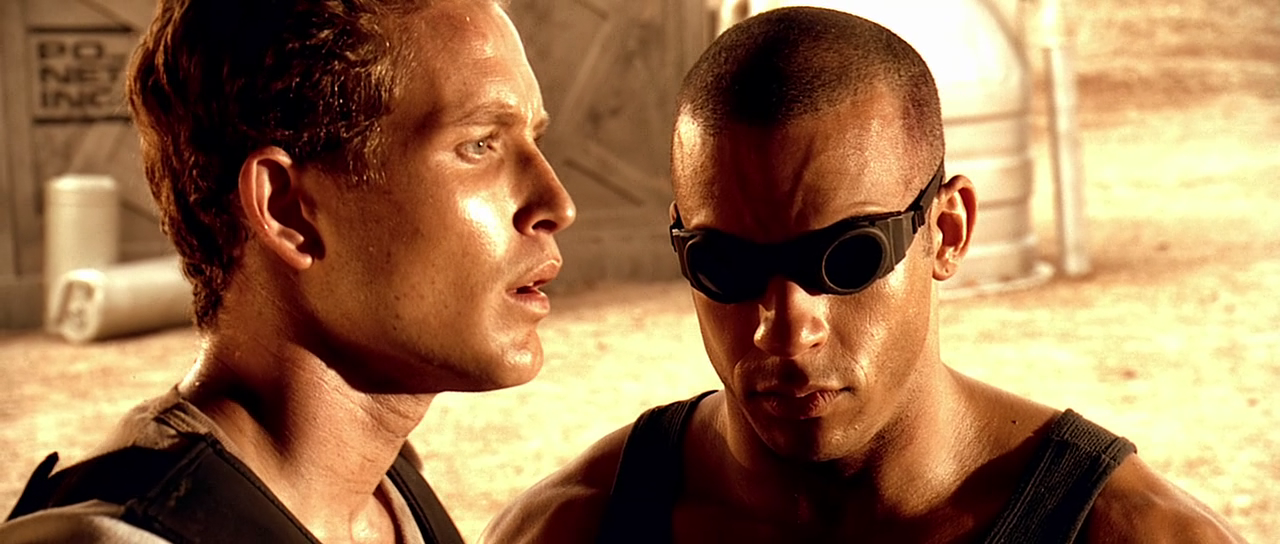
269 / 365: Pitch Black (2000)
© USA Films

I saw The Chronicles of Riddick in the theater back in 2004, dragged there by a friend and completely uninterested in the terrible effects, characters, and dialogue... but there was something about that Riddick fellow that made me think "I'd like to know more about this guy." Well, thankfully for me, there was a whole movie about him that I'd missed years and years before, one that was advertised more like a horror/sci-fi version of Flight of the Phoenix rather than the kick-off of a potential franchise—and introduction of one of my favorite action characters. I'm not surprised I overlooked this underrated film back in the day, but it surprises me that many movie fans still do. It's in this franchise where Vin Diesel proves just how big of a muscular bad-ass he truly is.

The year is whoknows, whocares... in deep space, a ship transporting a group of travelers in hyper-sleep hits an asteroid field, and surviving pilot Carolyn Fry (Radha Mitchell) makes an emergency landing on a nearby planet--a three-sun rock, origins unknown. With the ship destroyed and no means of communication, the recently awoken survivors explore the surrounding, desert-like land for signs of water, life, or a means of escape. When cop William Johns (Cole Hauser) reveals the prisoner he's transporting, a sub-human named Riddick (Vin Diesel) might be a danger to them all, the group goes on high alert and scrambles to power up the only working ship--that is until they discover that the planet is about to go into a month-long eclipse, awakening the flesh-eating creatures that live beneath the ground and fear the light. As the survivors begin dying one by one, Fry and Johns must turn to Riddick, whose ability to see in the dark may be their only way of escaping the planet alive.

Everything in this film is physical, to the point where we all feel exhausted. The grit, the sweat, the rain, the exertion of survival, all of it plays out in a hurried fever pitch. The lighting design also works overtime to convey this. The orange light is so bright and hot, the blue light is so cool and soft... and the darkness is utterly terrifying. The extremes compliment the film and add to the alien landscape, reminding us how uncivilized and un-populated this planet truly is. Diesel plays Riddick like an animal, and overly sensed creature that can easily go head-to-head with these creatures; we don't doubt it for one second. Everyone else is so human by comparison--emotional and overwrought, they'd never survive, regardless of strength and will. The film exceeds expectations in this way, pushing past mere horror and giving these people lives and personality and weakness. And we love Riddick all the more for being above all of it.

The graphics in this film are beginning to show their age, but the rest is still completely solid. The acting is exaggerated only where it matters, and Diesel's gruff voice and rippling muscles quite literally make the character of Riddick--he's flawed, he's dangerous, and he's sexy, but none of that is as impressive as how capable he is. Watching him plan and execute every aspect of their survival brings so much tension to the film. It's the reason why this character, not this film, went on to inspire two sequels, and likely more to come. Hands down, one of my favorite franchised characters of this century, and I can't wait to see Diesel bring him to life in something else. Guilty pleasure to the max.

Rating: ★★★½ / 5 stars
Watched: DVD
Seen Before: Yes

270 / 365: The Best Years of Our Lives (1946)
© RKO Radio Pictures

This movie was the #37 film on my AFI Top 100 countdown challenge. Read my full review here.

Rating: ★★★★ / 5 stars
Watched: DVD
Seen Before: Yes

© Run Rabbit Run Media


An open, honest, and patient documentary. Reminiscent of gut-wrenching, personal explorations like Dear Zachary, but as opposed to the fervent, violent energy and rush of storytelling, the reveals are slow. Our subject's close friend is telling her story, the stories of the people that knew Matthew Shepard before he was a victim in Laramie. And unlike Dear Zachary, you can feel the passage of time—the change in how they view their friend, their son. This is a boy who has been gone a long time, and whose story has been told in a variety of ways. But it's never been told like this, and that's why it's so important to his memory and legacy.

There is so much empathy you feel as a viewer, internalizing this exploration with Michele Josue, the filmmaker and Matt's friend. This is the film's most powerful asset. She reveals the painful juxtaposition between the outpouring of both love and hatred directed towards Matthew in the wake of his death, and towards what he represents. It's a brutally harsh perspective, and Josue's pain is echoed in the unprecedented interviews she does with those who knew him best.

Josue doesn't forget to inform you about who Matt was to the outside world. A young gay man living in Laramie, WY, who was found beaten nearly to death by two men because he reportedly flirted with them, later dying of his extensive injuries. The man who became the face of homophobic violence and crimes of hate, who inspired country-wide change in legislation and, moreover, triggered a conversation about how we treat the LGBT community in America.

No, Josue doesn't neglect to mention any of this, but she quickly takes us back to remind us that Matt was a person. A happy, bubbly, social child who traveled the world and experienced an adventurous life. A boy who grew to face challenges and fears as a young gay teen well before he could confide in anyone his secret. Ups and downs reveal a human being, not just a headline, and Michele Josue does a splendid job in constructing this story. It is a build to a tragic end that doesn't dwell on its finale. While it doesn't reveal much that wasn't known to anyone interested in Matt's life, the perspective is completely fresh. Down-to-earth and emotionally charged, it's a worthy cap-off to Shepard, usually only remembered for this notorious American crime.

Rating: ★★★★½ / 5 stars
Watched: Netflix
Seen Before: No

272 / 365: Gone in 60 Seconds (2000)
© Buena Vista Pictures

A movie starring all those people you totally forgot about from the early 2000s (I'm looking at you, Delroy Lindo)! And some who managed to star in TV shows so they'd stay relevant (lookin' at you, Timothy Olyphant)! A remake of the 1967 film of the same name (which I, admittedly, haven't seen), the new millennium kicked off with this enjoyably mediocre movie that gave all kinds of naughty feelings about pretty, shiny cars.

Notorious—and retired—Long Beach car thief, Memphis Raynes (Nicholas Cage), is pulled back into the game when his younger brother, Kip (Giovanni Ribisi), botches a job to boost 50 cars for new Big Bad on the block, Raymond Calitri (Christopher Eccleston). Now, he has 72 hours to get a team together to heist all the vehicles and save his brother's life. Tracking down an appropriately rag-tag group of former professionals proves easy enough—the Memphis-love runs real deep—but with a group of detectives (the aforementioned Olyphant and Lindo) hot on their trail, they must pull off the heist of every car in just one night to keep the police off their scent.

You've also never seen anyone have less chemistry with their on-screen love interest than Angelina Jolie has here with Nicolas Cage. I mean, it's not their fault, they're given absolutely nothing to work with, but the lack of tension between them is... what's the opposite of palpable? Google tells me 'imperceptible.' That sounds right. The script is terrible, just downright cliche. But one has to ask, is the script important? I argue that it's not, not even a little. Mundane dialogue aside, the formula is rock solid. A list of cars to check off, absconded in quick succession by a slew of awesome actors who look like they're having a blast? What's not to love about that??

Too bad Raymond Calitri as the villain is so lame and forgettable... this movie might have made a bigger impression, but Eccleston looks like Eddie Redmayne's older, more boring, less talented brother. He disappears for nearly the entire movie, replaced with sub-villains—guys from a different heist crew?—who are more useless than him. Then he reappears only to make the cops go "oh, well, I guess Memphis isn't that bad compared to this wackadoo." It's the most glaring aspect of the plot that totally guts the film. Thankfully, it doesn't take up too much time; the car-jacking is action-packed and exciting, and it's what we all walk away remembering. That and everyone getting horny listening to "Low Rider."

Rating: ★★½ / 5 stars
Watched: Netflix
Seen Before: Yes
Related Posts Plugin for WordPress, Blogger...